<?xml version="1.0"?>
<?xml-stylesheet type="text/xsl" href="atom-style.xsl"?>
<feed xmlns="http://www.w3.org/2005/Atom" xmlns:media="http://search.yahoo.com/mrss/">
    <id>https://corion.net/blog/tag/xml/</id>
    <title>Corions Musings</title>
    <updated>2025-11-07T00:00:00Z</updated>
    <link href="https://corion.net/blog/tag/xml.atom" rel="self" />
    <link href="https://corion.net/blog/tag/xml/" rel="alternate" />
    <generator version="0.098">Statocles</generator>

    <entry>
        <id>https://corion.net/blog/2025/11/07/rss-style/</id>
        <title>RSS.Style: Better UX for your RSS and Atom feeds!</title>
        <link href="https://corion.net/blog/2025/11/07/rss-style/" rel="alternate" />
        <content type="html"><![CDATA[
            <p><a href="https://www.rss.style/">RSS.Style: Better UX for your RSS and Atom feeds!</a></p>

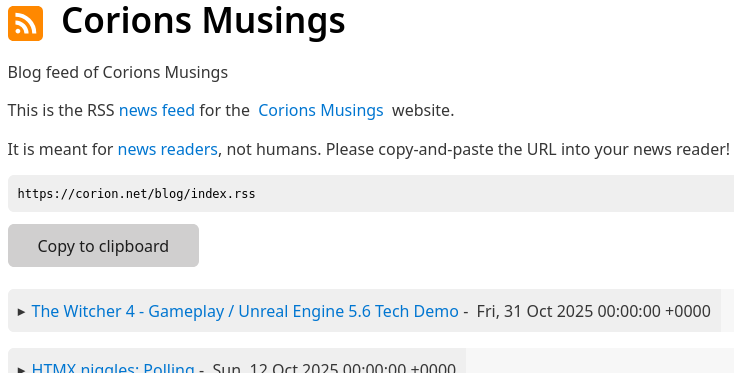
<p><img alt="screenshot of RSS feed styled with XSLT" src="https://corion.net/blog/2025/11/07/rss-style/styled-rss-feed.png"></p>

<p>In true old-skool fashion, even my RSS feeds are now also
<a href="https://corion.net/blog/index.rss">viewable in the browser</a>, thanks to the
XSLT stylesheets from <a href="https://www.rss.style/">rss.style</a>. They rewrite the
XML into something a browser can render. Obviously using a proper RSS
reader, like Thunderbird is better, but hey!</p>


                <p>Tags:
                    <a href="https://corion.net/blog/tag/linkblog/">linkblog</a>
                    <a href="https://corion.net/blog/tag/xml/">xml</a>
                </p>

        ]]></content>
        <updated>2025-11-07T00:00:00Z</updated>
        <category term="linkblog" />
        <category term="xml" />
    </entry>
</feed>

